

Mid
On Onlyfans and the K-shaped economy and why being Mid is the worst thing you can be

Remember when the middle was a perfectly respectable place to be?
If a product was reasonably priced, reasonably well made, and reasonably widely distributed then it could expect a reasonably stable existence. A brand could be solid without being anything spectacular. A restaurant could be dependable without being exceptional. A television programme could be mildly entertaining and still garner millions of viewers every week. Even workers could be of middling competence and phone it in at an unremarkable mid-market company and still expect to enjoy a comfortable middle class lifestyle.
The middle meant safe. And for much of the twentieth century it was arguably the best place to be.
You were not the cheapest option, nor the most luxurious. Not the best, nor the worst. You were somewhere in between, occupying a snug, congenial plateau where general, unflashy competence met the scale of a steadily growing and absolutely huge economic market.
In many industries this position was highly desirable strategically. Extremes were risky and full of weirdos, places to be avoided. The middle was safe, welcoming, potentially lucrative if you could scale up to it.
But then, something cataclysmic happened over the past decade.
The middle seemed to stop working. Eventually, the middle became ‘mid’.
Let’s look at the cataclysm through the geometry of our modern economy.
During the boom of the post-war period, economic distributions tended to resemble something close to a bell curve. Most outcomes clustered around the centre. Outliers existed of course, but the centre of gravity remained relatively stable.
But today markets no longer resemble a bell curve. They resemble the letter K.
In a K-shaped economy a small number of participants accelerate rapidly upward while everyone else either stagnates or declines. Growth concentrates at the top. Precarity underlies everything else.
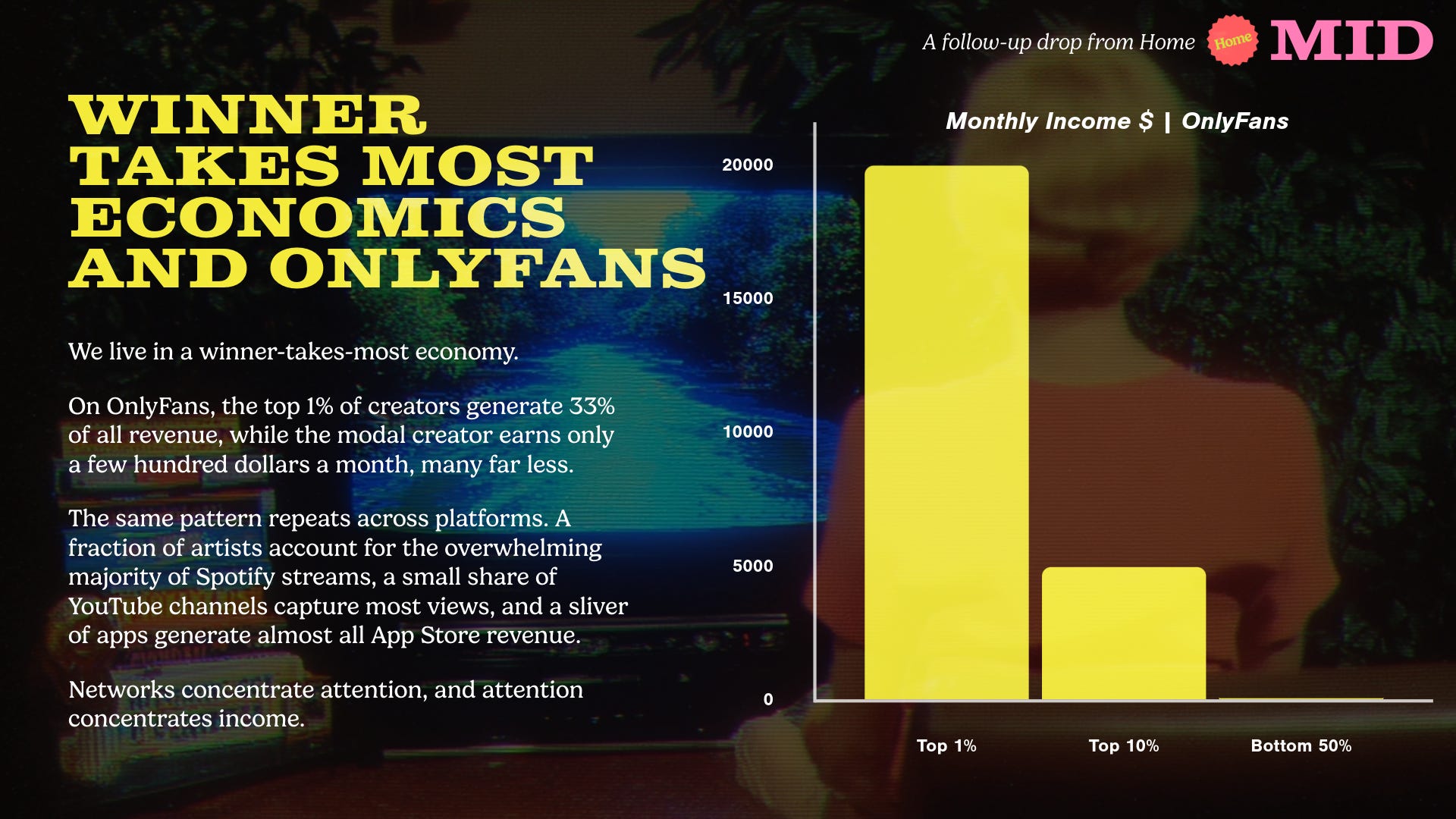
The K pattern is observed in wages, housing markets, cities, media consumption, and corporate performance. The same logic increasingly governs culture itself. The K-shaped distribution extends to Spotify streaming numbers and Onlyfans content creators.
We have, as an economy and as a society, entered the K-hole.
And so, the middle becomes a precarious place to live. The middle is mid.
The underlying reasons for all this have a lot to do with networks.
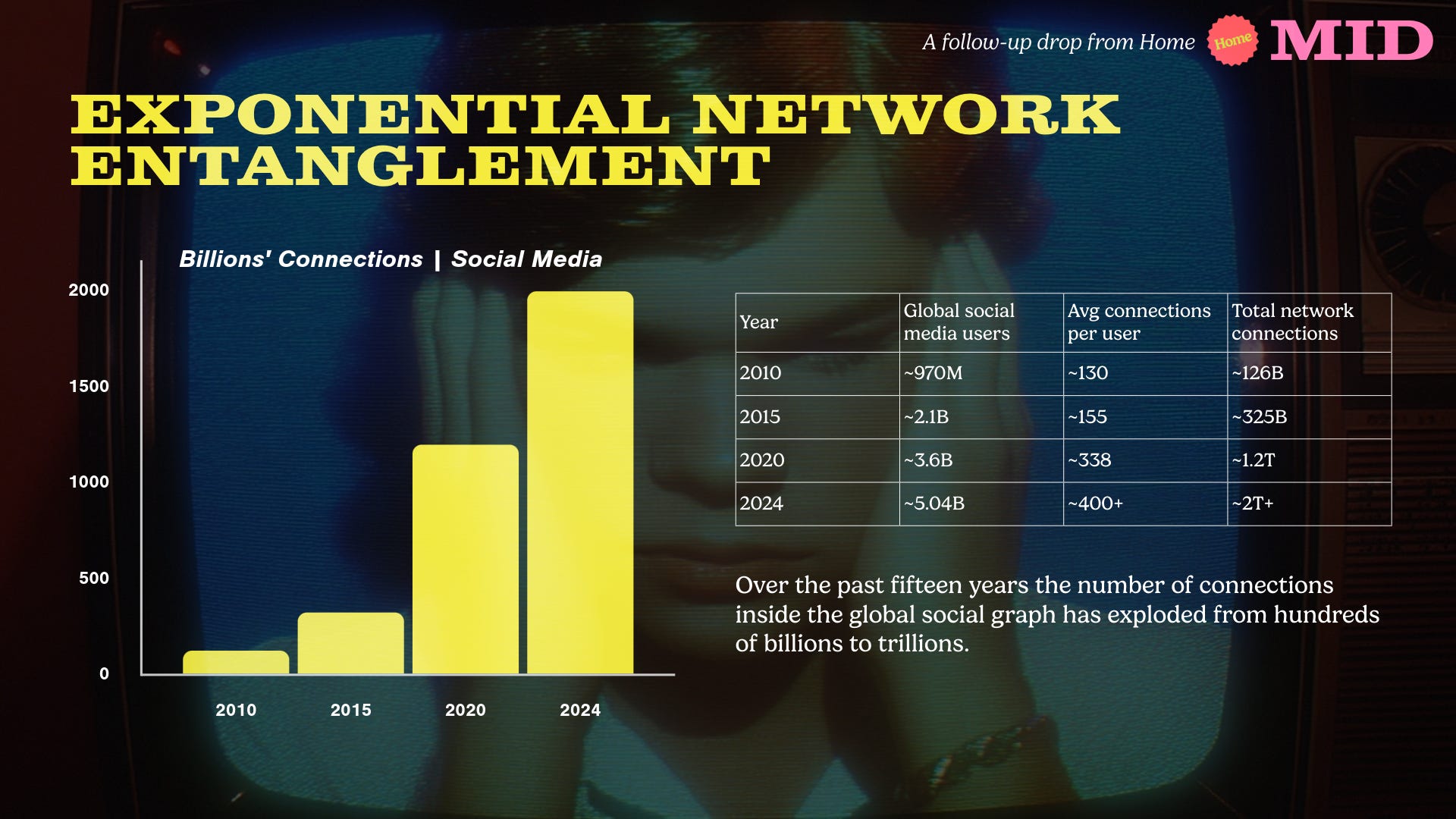
Modern markets are not flatly parochial binary clusters of buyers and sellers. They are enormous, entangled networks of attention, distribution and recommendation. And these networks behave differently from traditional markets.
They produce what clever maths boffins call power law distributions.
Instead of outcomes clustering around the average, advantage compounds around a small number of nodes. The popular becomes more popular. Visibility attracts further visibility. Success feeds on it’s own success.
Preferential attachment is the next bit of mathematic lingo and it explains the phenomenon. When people encounter a network they are more likely to connect to the things that already appear prominent because other people within their network are constantly reinforcing the prominence of those things. Which means the prominent things grow more prominent still.
That is a lot of prominent. But simply put, some things just snowball, and networks reward snowballs by making them even bigger.
The result here is that relatively small differences in visibility and timing produce enormous differences in outcomes.
This pattern is painted on the walls of every modern tech platform.
A fraction of musicians generate the vast majority of streams on Spotify. A similarly small percentage of YouTube channels capture the overwhelming majority of views.
The same dynamic appears in software. A microscopic share of apps generate nearly all of the revenue in the app stores.
Winners stay winning. The rest fade into statistical background noise.
The best time to plant a tree was ten years ago, the second best time is today. On the other hand, the best time to start an Instagram was ten years ago, but now? Maybe try your luck on substack instead.
On top of this inherent dynamic of networks sits another force: algorithms.
The feeds that mediate modern attention are not neutral conduits of information. The facebook ‘timeline’ died over a decade ago. Today’s feeds are ruthless optimisation machines.
Their task is to surface the content most likely to produce a reaction. Balance be damned.
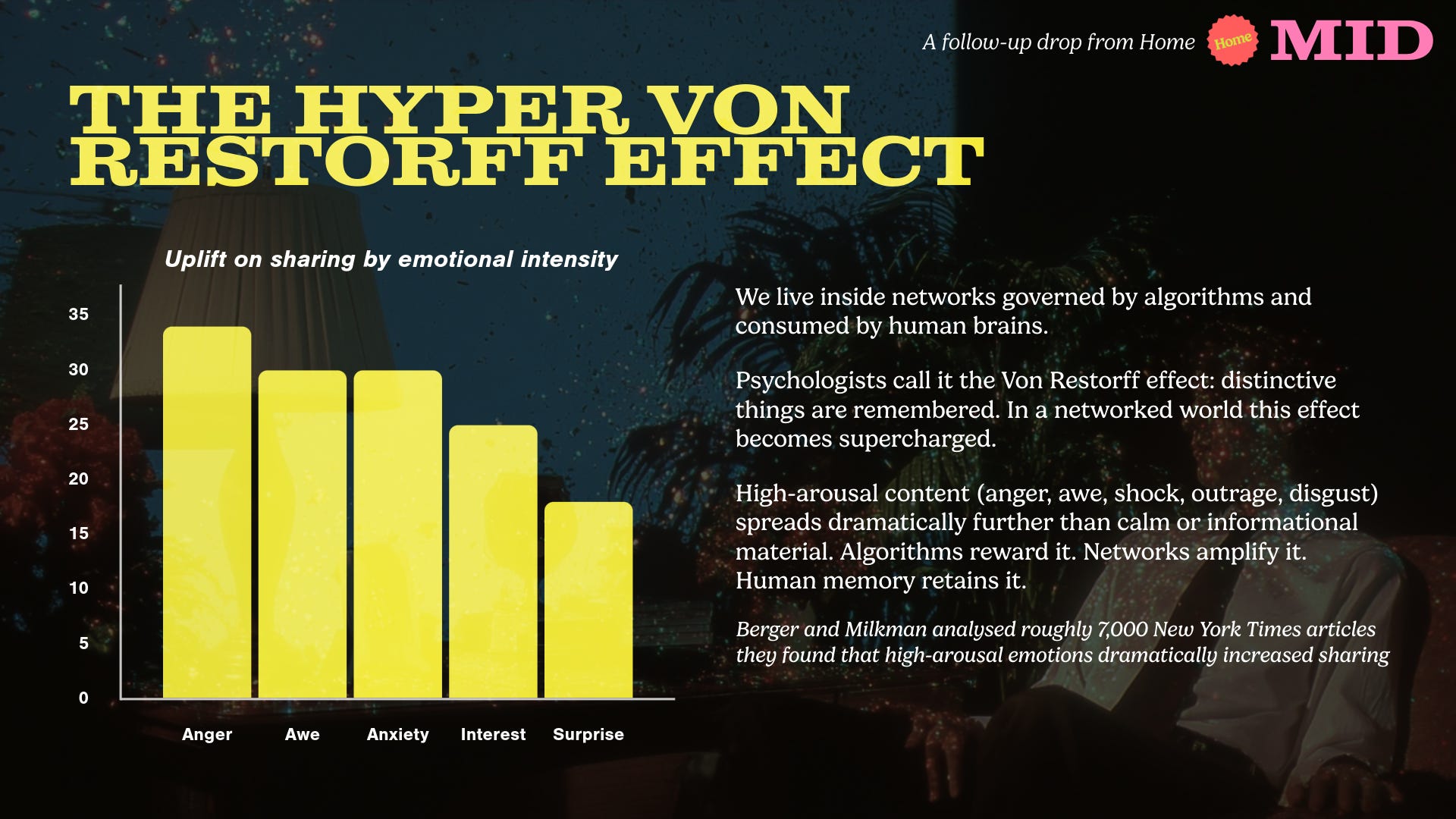
Reactions tend to favour intensity. Our feeds feed upon arousal.
Material that provokes laughter, anger, fascination, surprise, terror, disgust, dread, fury or any other similarly visceral response will travel further than material that seems merely informative. All signals that spike sharply above the baseline are amplified.
Which means the feed has very little interest in the middle.
If something is not clearly the most something, the system struggles to notice it at all.
At the bottom of the K-hole is a revelation: It is now worse to be mid than it is to be bad.
Bad things can be memorable. Kitsch. Niche. Cult. Quaint.
Terrible films can be cult classics. Awkward ads become internet memes. Anything bizarre might develop a strange and ironic fandom.
Likewise, failure might be failure, but at least it still generates the kind of signal that networks, algorithms and preferential attachment can work with.
But Mid generates nothing. Zilch.
Mid is not loved enough to inspire devotion and not strange enough to provoke curiosity. It produces no spike in attention, no memorable imprint in the mind, no compelling reason to choose it over the alternatives. No compulsion to share an opinion.
Mid does not offend. Mid does not excite. Mid does not register. The bell curve has inverted, To be Mid is to call the valley or irrelevance home.
The germane point to all this for business and brands is that many modern organisations are designed, even if just implicitly so, to produce midness. In a lot of ways they are systematically calibrated to generate it.
Corporate decision making rewards legible predictability above all other attributes. Ideas pass through committees, who through bias or design, consistently smooth out sharp edges. Product decisions are guided by benchmarks and averages. Communication is refined through rounds of testing designed to remove anything potentially controversial.
Each of these factors might appear sensible in isolation. But taken together they produce a machine optimised for the creation of the least objectionable possible output.
Which is to say: the middle. Maximum Mid. Mid-maxxing.
The various tools we use reinforce the pattern.
Performance dashboards measure incremental improvements. Consumer research surfaces majority preferences. Net Promoter Scores, perhaps the most obviously mid-calibrated of all metrics, reward experiences that avoid generating strong negative reactions.
Even the phrase best practice is revealing in it’s obfuscation.
Best practice rarely refers to the genuinely best thing anyone has ever done. It refers to the most widely accepted compromise currently circulating within an industry.
The result of all that, our technology, our operations, and misaligned individual and organisational goals, create a powerful gravitational pull toward the average. And the average, in a preferentially attached, power law dominated, complex networked environment… Well, that is precisely where the least value accumulates.
Against this backdrop the brands and creators that succeed today share an unusual characteristic.
They are not balanced. Instead they tend to occupy a very specific superlative.
The most irreverent canned water.
The most aggressively fermented hot sauce.
The loudest fast-food stunt.
The most obsessive coffee ritual.
The most cheap low cost airline.
These brands are rarely trying to be good at everything. They are trying to be the most at something.
And this turns out to be a far more effective strategy in a world governed by attention networks.
Being “the most” does not necessarily mean being the best in some objective sense.
It simply means occupying an unmistakable position.
Most weird.
Most cheap.
Most expensive.
Most obsessive.
Most luxurious.
Most ridiculous.
Most simple.
Most intense.
The particular dimension matters less than the clarity and consistency and distinctiveness with which it is expressed. When a brand pushes a single attribute far enough to become unmistakable it creates a spike in perception. People immediately understand what the thing is and who it is for. People immediately recognize it when they see it.
And once that spike exists, the network begins to do what networks do best. Amplify it.
This suggests a very different approach to strategy.
Instead of assessing in aggregate and trying to optimize every metric simultaneously, organisations are better served by identifying one attribute worth exaggerating. And instead of asking whether an initiative will appeal to everyone, they might ask whether it will be unforgettable to someone.
The goal shifts from balance to deliberately superlative.
The only way to claw your way out of the K-hole is to give up on being good at everything and embrace being the most at something.
This was my favourite read this week. Brilliant writing, such a good analysis of K shaped influence. Nice (:
so well observed and analyzed