

Are You Winning Yet?
Scoreboards and the modalities of success

Winning feels pretty good, doesn’t it?
I mean, seriously. Who doesn’t like to win? It feels irrefutable. A scoreboard that says you’re ahead. Headlines that confirm you’re great. The beguiling green arrow that points up and to the right.
Yet scoreboards only measure what they measure. In the vast majority of human endeavours, things aren’t quite that simple. You might say that ‘winning isn’t everything’ if you wanted to put things more idiomatically. In fact, it turns out that very often, winning is not even in the same ballpark as success.
Which brings me to Donald Trump. Whatever you think of the man, he is a case study in conflating tactical wins with strategic achievement. Tariffs announced with maximum fanfare, then paused, then renegotiated. Trade deals declared done that aren’t done. Every day a new scoreboard, every scoreboard manipulated to show a victory. The activity is relentless, the velocity is constant, wins are announced before they’ve happened and yet it is impossible to identify any coherent through-line that would tell you what all of that winning is actually for. What is the compounding position? Where does this take us? These questions do not receive an answer, because the next win is already being announced.

This is part of what I would call anti-strategy. It isn’t really just a ‘bad strategy’, it’s a total absence of it. An entire worldview in which accumulating wins is the strategy. Breakneck momentum substitutes for direction, and the scoreboard is itself the objective. Everything rests on a recursive, tautological, maximally Goodharted fallacy: The idea that you can win your way to victory, if you just win enough things.
And I know what you’re thinking. You’re thinking: that sounds like advertising.
When Winning At Winning Works
Before we get into where the wheels fall off all that winning, it’s worth pausing on the domains where the purely tactical, win-each-thing approach works. These domains exist, and the contrast with more strategic ones is instructive.
The exemplary case is the Olympics. In the 100 metres, the strategic complexity is close to zero. You run as fast as you can. The person who runs fastest wins. Usain Bolt does need not worry that winning the semi-final will inadvertently strengthen Jamaica’s trade rivals. He needs to be quick.
And at a national level, winning the Olympics is as simple as accumulating the most gold medals. More tactical wins equals overall victory.
Same with spelling bees.
These are finite games with transparent rules where tactical excellence and strategic success are basically the same thing.
The trouble starts when people take that bounded mental model and apply it to unbounded domains. The 100 metres has a finish line. Brand-building does not. Marketing is of course part of business, which means it is exactly the kind of unbounded space where winning each thing and achieving success are wildly different propositions.
The marketing industry runs on a similar version of anti-strategy.
Most obviously when you think about performance marketing. Each click or conversion won is a tactical victory. The dashboard is glowing green. Never mind if the brand might be atrophying underneath it all. The long-term demand that brand distinctiveness and meaning contributes is harder to measure, therefore it doesn’t get measured, therefore it doesn’t represent the sort of immediate tactical win that scoreboard based anti-strategy demands.
On the other end of the spectrum is a similar story; award shows. Lions and Pencils. An agency can rack up a cabinet full of trophies without doing anything meaningful. These are tactical wins in the most literal sense. Never mind that the agency may well be haemorrhaging clients, and simply producing work that makes them famous for ads that nobody outside the industry has ever seen. A ‘Mission Accomplished’ banner on an aircraft carrier parked up at the beach in Cannes.
Those are just the obvious, highly visible symptoms of a pathology that runs deeper.
The strategy at most agencies, and I don’t mean strategy as a department here, I mean the strategy for the agency itself if you can call it that, goes something like this: win more clients so we can hire more people so we can do more and better work, so that we can win more clients…
The quality of the work, the thing an agency exists to produce, is positioned as the payoff at the end of an infinite loop, permanently deferred, always one more pitch win away. More first, better eventually.
This is the agency version of ‘win enough things and victory will follow.’ And with it comes the exact same flaw: it mistakes a temporary condition for a long term strategy. Growth is a condition. Scale is a condition. They’re not strategies. A strategy would ask: what kind of agency do we want to be, who do we want to work with, what work do we want to be known for, and what is the sequence of decisions and trade offs that gets us there? The growth-loop answer to that question is: whatever makes us win. The answer of someone who has confused the scoreboard for the thing it is measuring.
Scoreboards, Moodboards, Springboards
So to avoid sounding like a grumpy old man shouting at clouds, let’s properly dimensionalise this. I don’t think it’s a simple binary. I reckon there are actually three distinct modes of ‘success’, each one its own modality of evaluating whether things are going well, and most of the confusion in business, and in advertising, and in geopolitics, comes from mixing them up.
The first is the Scoreboard. This is where the score reflects the outcome. The rules are transparent, the game is bounded, the feedback is immediate, and the thing you’re measuring and the thing you care about are the same thing. Win each thing and you win overall. The scoreboard tells the truth, but only a tiny slice of it that is mostly divorced from context. In marketing, this is performance: clicks, conversions, ROAS, A/B test results. Discrete, countable, attributable. Did the number go up? Good.
The second is the Moodboard. This is where what matters is qualitative, subjective, multidimensional, and can’t be reduced down into a number, maybe it can’t even be reduced into a word. I suppose you could say this is mostly about ‘vibe’. Does the brand feel coherent? Does the work have a distinctive tone? Is there an idea holding everything together? This is the world of craft, creative excellence, taste, and cultural intuition.
The third mode is the Springboard. This is where the question is not ‘did we win?’ or ‘does it feel right?’ but ‘where does this take us?’ The springboard is about building a compounding position over time. It’s about whether today’s actions are building toward something. Is it creating options, strengthening our advantages, accumulating strategic capital that makes future victories more likely. It’s the domain of strategy: not the score, or the vibes, but the trajectory.
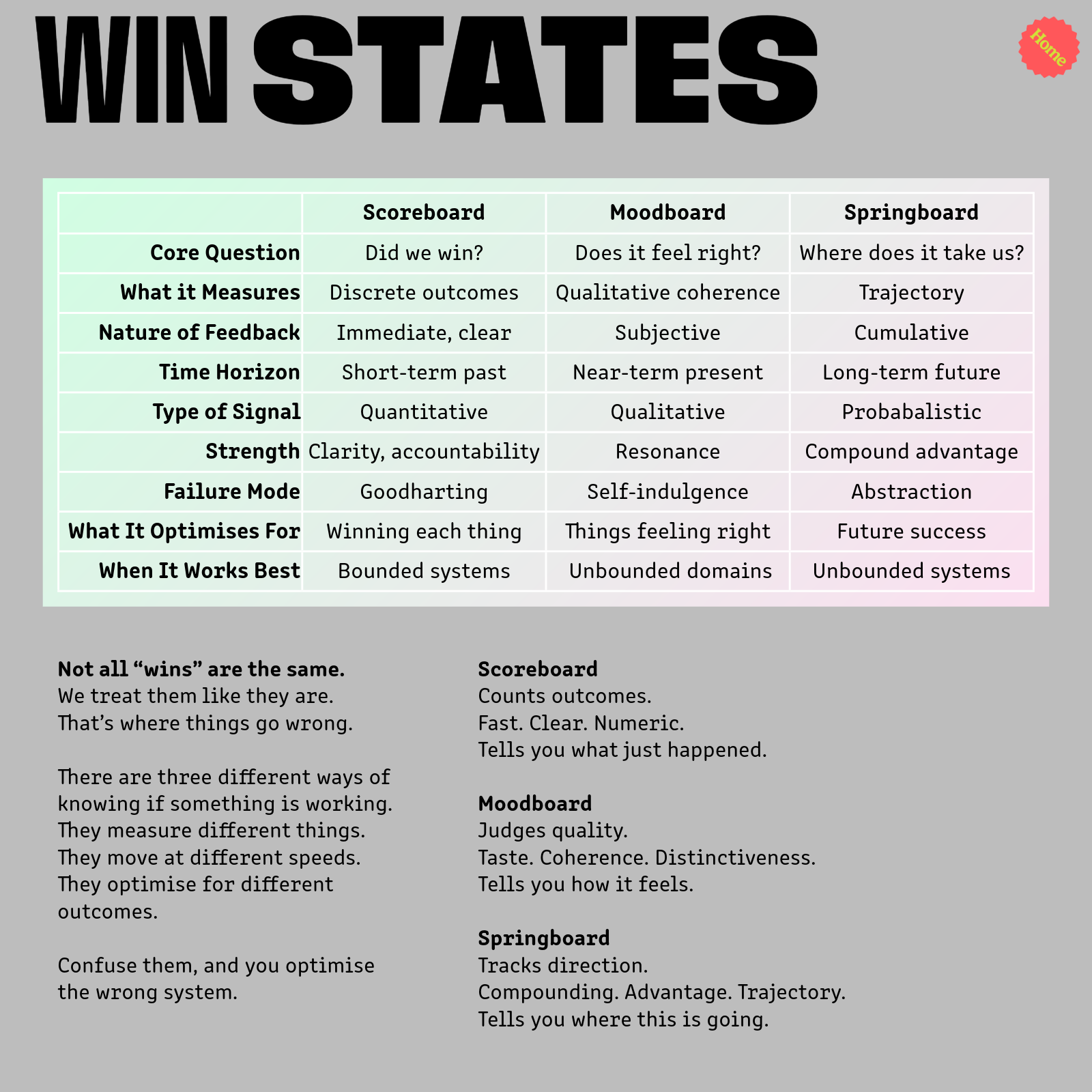
All three of these are real and all three have a legitimate role to play. None of them is wrong. But it is ruinous to confuse them, or to assume that success in one automatically produces success in the others.
You can win on the Scoreboards, smashing your performance targets quarter after quarter, while the brand atrophies underneath because nobody is doing any Moodboard work. Likewise, you can nail the Moodboard with a beautifully coherent brand world and awards coming out of your wazoo, while the business goes nowhere because nobody is doing Springboard work. And you can have a brilliant Springboard strategy on paper that never makes any difference because the tactical execution is sloppy and the creative is boring.
Perhaps the critical insight is that the industry is somehow stuck in a binary death match between the Scoreboard and the Moodboard. Performance vs brand, data vs creative, quant vs qual.
Meanwhile the Springboard question sits ignored and twiddles its thumbs. Nobody really owns it. The performance team is optimising clicks. The creative team is crafting vibes.
And the question of whether any of this is actually compounding into a durable position? That’s often nobody’s job.
Brilliantly articulated. And miserably accurate. I've been trying to explain this idea to my coworkers for years, and irritatingly you've done it better than I ever have in a single post. But the nice thing is, said post can be shared...
Brilliant work, sir. There’s something about the definitive, quantitative nature of winning that humans find alluring but not all that satisfying. Hollow, Pyrrhic victories and all that