

Just One Last Thing
I love Columbo. Completely unironically.

It’s comfort TV, but it’s also an entire philosophy wrapped in a crumpled beige raincoat.
The odd thing with Columbo is that everybody focuses on the ‘gotcha moment’ at the end. The “Just One Last Thing” bit. And yeah, don’t get me wrong that bit is really great. But there is actually something much better going on in Columbo than the bit with him snaring the murderer.
And it’s something that nobody really talks about, which I find really weird because it’s my favourite thing about the show. I like this thing about Columbo even more than his charming anecdotes about his wife and the fact that his dog is simply named “Dog”.
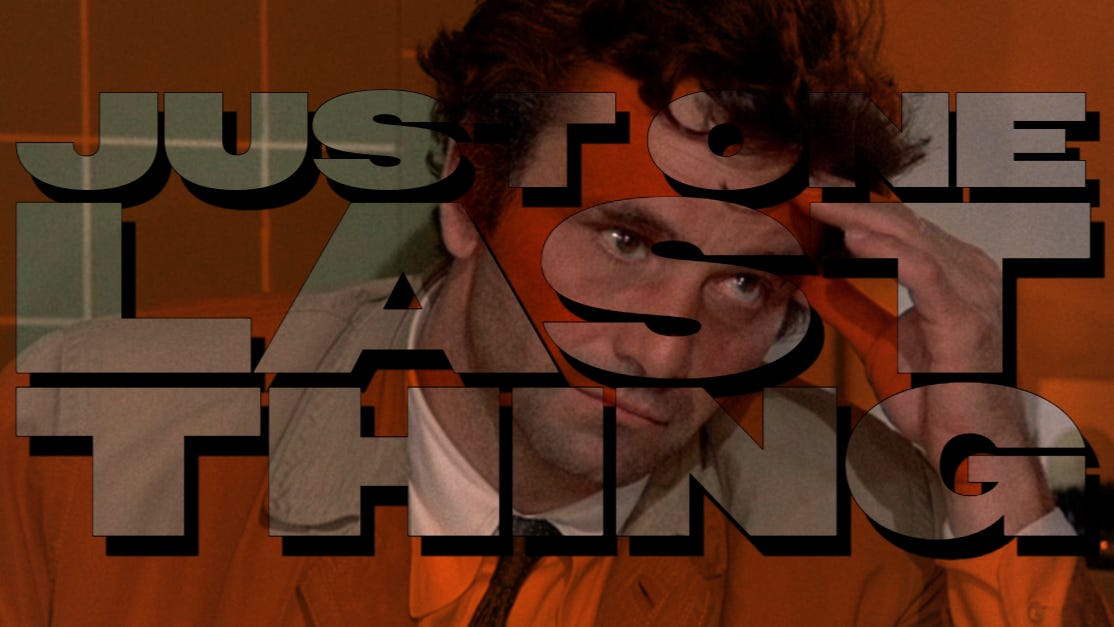
The absolute best thing about Columbo is that he already knows who the killer is.
Right at the start. Before he interviews any witnesses, and before the murderer has even finished the smug monologue where they protest their innocence.
Columbo just meanders into the crime scene, squints at a lampshade, apologises a lot about being so annoying, and then you see Peter Falk act out, in his own idiosyncratic mime, everything clicking into place inside his head.
This bit usually takes place within about the first five minutes of an episode of Columbo, just after the prologue in which we the viewers get to see the actual murder happen.
After that, the whole rest of the episode is just Columbo gathering enough evidence to make everyone else catch up with what he already knows. Oh, and annoying the murderer with his unassuming but irritating persistence.
And I think that, if you work in strategy at least, probably sounds familiar.
Strategy is Knowing. Evidence is Explaining.
There is this infuriatingly widespread misframing that strategy emerges from a fixed sequence of steps.
But that’s not how it works inside the human brain.
Strategy mostly happens in the exact same way that Columbo spots the thing that’s “just a little bit off”. It’s a specific moment when you notice something in the pattern is off. And suddenly things click.
Just like Columbo, strategy arrives before the evidence. The idea arrives ‘in media res’, The slides come later. The justifications, the rigour, the charts, the “from to” narratives, the decks. Those are all things we build after the strategy has already landed. Just like Columbo.
We Have To Pretend It Works the Other Way Around
Modern firms have a bias towards evidence. They hoard it and act like decisions become more correct with every additional morsel of it. This is a very curious thing to me.
I have some hypothesis on why, this probably deserves its own article but for now here’s a topline:
1. Bureaucratic Power Theory
The more evidence an organisation demands, the more power shifts to the people who manage the evidence. The more power in the hands of people who demand evidence, the more they can use that power to demand more evidence.
So bureaucrats love evidence because it expands their territory, every new metric creates a new checkpoint only they can approve. It’s Stalin-by-spreadsheet: control the paperwork, control the process.
2. Disembodied Human Theory
As a species we’ve become overthinking brain-blobs. We’re analysing, intellectualising, philosophising, and opining, and so we’ve completely lost touch with the part of us that actually acts. When we lose contact with our physical, doing-self, evidence gathering becomes a more compelling pursuit than action taking.
3. Lazy Cowards Theory
Gathering more evidence is the perfect stalling tactic. If you’re scared of being wrong or taking accountability, nothing beats “let’s do another round of research”. Evidence is a way to be lazy and timid whilst looking like you’re being smart: if the numbers made the decision, nobody has to.
For now let’s just say that people seem to love gathering evidence more than taking action.
This is how you end up with people confusing strategy with the evidence of the strategy. I call this Dreck, and I made a small thing about it a couple of months ago.
This is probably also why so much strategy gets lost in bureaucratic miasma. Everyone is waiting for permission to agree with something that they already know anyway.
It’s strange how institutional life trains people to distrust intuition.
Columbo would not survive this environment.
Oh, and just one last thing…