


You can call them Pointies and Softies, or sharpies and squishies, or spikeys and fluffies, or whatever you like. The naming is just a kind of dumb thing to help it lodge into your brain. What matters is that pretty much every person you’ve ever worked with sits somewhere along this spectrum.
On one end you have the Pointies. Pointies move through the world by deciding things. They form a view, pick a direction, choose an answer, and then they spend their energy turning that thing into a real thing. They focus on the object. They ship. To a Pointy, the world is largely a place you do stuff to.
On the other end you have the Softies. Softies operate the other way around. They take their cues from the people they’re with. They listen. They use intuition to suss out what folks collectively want, and forge an answer downstream of that. To a Softy, the world is a place you do stuff with.
The urge here is to immediately decide one of these is the good one and the other is the bad one. So we should head that off. Pointies aren’t smarter and Softies aren’t kinder. Neither orientation has any moral or intellectual superiority. They’re just two different default postures for getting through life. Most people I’ve worked with are somewhere along this paradigm, and the ones who genuinely sit in the middle are rare, and worth their weight in gold.
Guess What? It’s Not a Spectrum, It’s an Axis
The Pointy/Softy thing is interesting on its own. It gets considerably more interesting when you cross it with a second question, which is: who do you choose to be surrounded by?
Because it turns out that whether you are a Pointy or a Softy is only half of the story, and like I said before, neither is superior to the other really. But the other half is whether the people you stack your professional life with are Pointies or Softies as well. Slap that on the other axis and we’ve got ourselves a 2x2. And I do think that there are some of these quadrants that seem to produce better outcomes, and others that have certain issues. In fact, I think most of them have issues but some of those issues are much worse than others.
Four quadrants, each a wildly different working environment.
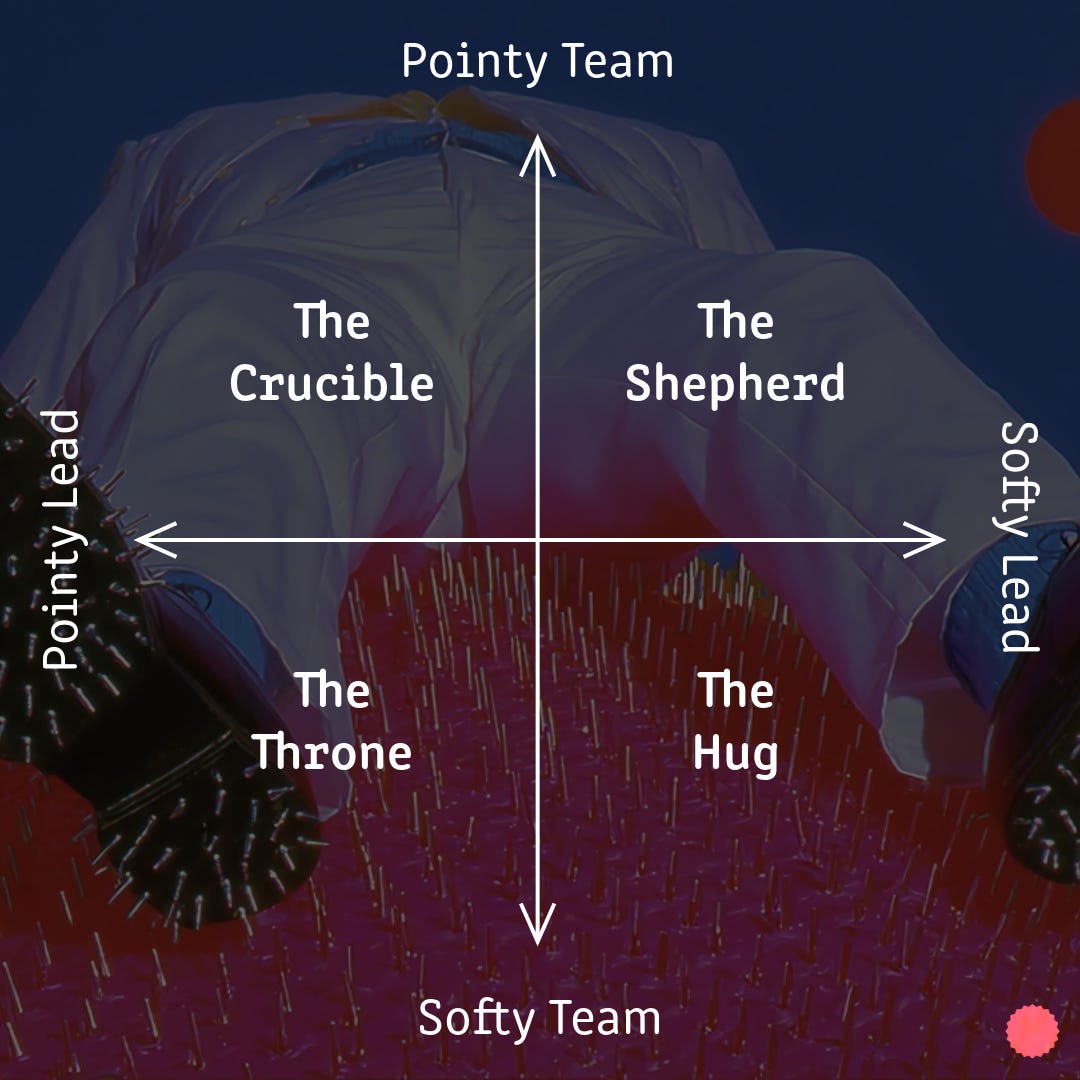
Pointy × Pointy: The Crucible
Pointies who surround themselves with other Pointies live in The Crucible. Welcome to debate city. Hegel HQ. Argument as the primary mode of progress: thesis, counter-thesis, synthesis, lather, rinse, repeat.
When it works, it really works. Ideas get bashed against other ideas with sufficient force that the brittle ones break and the durable ones come out the other side stronger and infinitely more useable. Pointy × Pointy environments produce some of the best thinking in the world, in history, ever.
The downside is that not everyone enjoys living like this. Constant disagreement is exhausting. Egos erupt. Bystanders cower. And the Crucible has a habit of optimising around the most rhetorically dominant Pointy in the room, who is not always the smartest one in the room.
Pointy × Softy: The Throne
This is a classic. A Pointy with strong views surrounded by a layer of Softies whose job is to make the strong views happen. The corporate monarchy. The founder-led firm with the deferential C-suite. The visionary, attended.
It appeals strongly to two specific and opposite psychologies. On one side, the people who genuinely enjoy bossing other people around, or psychos they’re usually called . On the other side, the people who would frankly prefer not to have to think for themselves. There is more than enough of both psychologies to keep this configuration well stocked in perpetuity.
For most of us it is the worst place to be, but it can be extremely productive, particularly if the Pointy in question is brilliant. But the fail state is well documented. The Pointy gets cocooned, the Softies stop pushing back, the orbiting yes-machine produces an increasingly unchallenged stream of decisions, and one day everyone discovers they’ve been steaming towards an iceberg made of frozen human vomit for the last eighteen months. Theranos. FTX. The USSR.
Softy × Softy: The Hug
Softies who surround themselves with other Softies are in The Hug. The Hug is, structurally and definitively, an alignment and consensus machine. It will consistently arrive at a position that every single member of the group can live with.
The Hug does not ever produce great work. The Hug is neurotically averse to the conflict and tension necessary for innovation to occur. The Hug will, however, wear you down with endless calibration and gentle emotional triangulation until everyone is fully aligned on a thoroughly mediocre thing that no one is excited about and no one can really complain about either and that is okay because if you cared about the quality of the output you wouldn’t be in The Hug anyway.
But! Here is the small consolation prize: The Hug avoids difficult conversations almost entirely. So if your overriding goal in life is to never feel awkward, The Hug is genuinely your best option. And probably a wise one in many ways.
Softy × Pointy: The Shepherd
This is the dark horse. The mercurial outsider. The secret savant. A Softy who deliberately surrounds themselves with Pointies. The super-coach. The leader who finds balance across a rag-tag bunch of mavericks. The boss who can’t necessarily out-argue any of their team but holds the whole shape of the thing together regardless.
Done well, this is one of the most effective configurations on the planet. You get all the variance and conviction of a Pointy bench with a Softy steward making sure the team doesn’t tear itself apart in the Crucible. It is how a great many of the best film studios, bands, and maybe creative agencies have ever worked.
But, and this is a fairly big but, it requires a properly high-skill Softy. Most Softies, parachuted into a room of Pointies, get swallowed. They retreat into nodding and harmonising and the Pointies promptly start running roughshod. The successful Shepherd is a Softy with steel in their spine and a fine sense of when to step in and bash some Pointies down a peg or two. Albeit bashing softly.
So What’s the 2x2 For?
Three of the ways this is useful.
A diagnostic for teams you’ve been on. Most of the time when you remember a team as amazing or terrible without being able to put your finger on why, the answer is the quadrant. The Crucible feels like a war zone if you’re a Softy. The Hug feels like Sarin gas nerve agent if you’re a Pointy. The Throne is fine if you accept the deal, miserable if you don’t.
A diagnostic for hiring. We hire primarily for skills and then culture-add and then a longlist of various other vague things. We tend to skip the much simpler question of whether the person they’re bringing in is a Pointy or a Softy, and whether that is actually what the team currently needs.
A diagnostic for yourself. If you’re miserable at work and can’t quite say why, there’s a decent chance the quadrant is to blame. I am a Pointy, I like working with other Pointies, I don’t mind being managed by a Softy as in the Shepherd zone - but plop me into the Hug and I go legitimately insane.
In Closing
There’s a maybe weirder insight buried in this 2x2, and it is worth pulling out before we wrap up. Organisations tend to drift, by human bias and default, towards Pointies at the top and Softies underneath. The Pointy gets the corner office, the Softies fill the layer below, everyone slots into a sort of horrific natural order, the org chart has a spikey head and a fluffy bottom.
But look at what our axis is telling us. Softies underneath is the structural state of The Throne and most of The Hug. It’s the bad answers. Unless you happen to be a Pointy psycho who enjoys being deferred to, or you’re cheerfully dialing it in inside The Hug, Softies underneath is something to actively work your way out of, not towards. The configurations that produce great work either stack Pointies together in The Crucible and hopes they don’t kill each other, or, far more rarely, and much more effectively, it inverts the instinctive gravity towards softies on the bottom and puts a Softy on top in The Shepherd.